You moved into your apartment, bought a sofa because that's what you do, and now you're sitting on it sideways with your legs over the armrest, a throw pillow wedged behind your neck, wondering why you spent $1,400 on something you use like a pool float.
Sofas are the default. You buy one because everyone has always bought one. But the question worth asking is whether that default actually earns its spot in your living room, or whether it's just taking up space because you never considered the alternative.
This is the comparison we wish we'd had before buying our first couch.
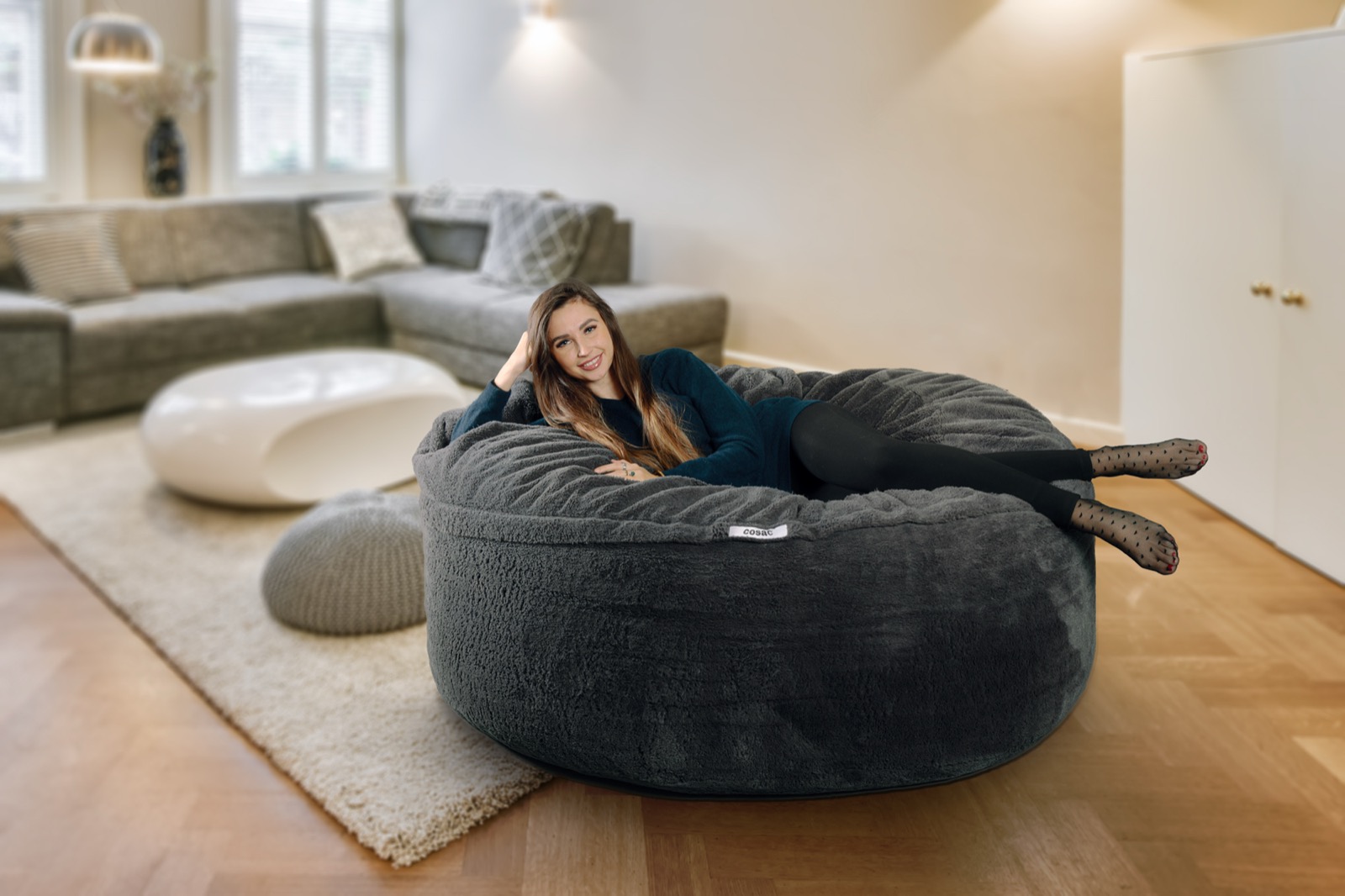
Comfort
A sofa is a rigid frame with cushions bolted to it. The cushions have a shape, and your body is expected to fit that shape. You get one posture: upright, feet on the floor.
Everything else (sideways, curled up, legs tucked under you) is working against the design. That's why you keep adjusting every 15 minutes.
A beanbag has no frame and no opinions about your posture. The filling shifts around your body and supports whatever position you land in. Sit upright, lean back at 45 degrees, go fully horizontal. It adapts.
The Cosac uses shredded memory foam, which responds to body heat and weight. It molds around you and distributes pressure across a much larger surface area than any sofa cushion. That's why people sink into it and don't move for 3 hours.
There's a moment, about 90 seconds after you sit in a beanbag, where the foam finishes settling around you and your shoulders drop about half an inch. You didn't know they were tense. That never happens on a sofa.
Sofas win on one thing: sitting upright at a dinner party with a glass of wine. For everything else you actually do on furniture (movies, reading, napping, scrolling), the beanbag is more comfortable.
Durability
Sofas have a reputation for lasting "10 years." In reality, the decline starts around year 3. Cushion foam compresses and doesn't bounce back. Springs lose tension. That one seat nobody picks develops a permanent sag.
By year 5, you're propping things up with throw pillows and pretending it's fine.
Re-stuffing sofa cushions runs $200 to $400 per cushion. Reupholstering the whole thing can hit $1,500. The realistic outcome: you live with a saggy couch until you replace it.
The Cosac's shredded memory foam will settle over time (all foam does), but you can top it off with a $30 refill bag every 18 to 24 months. Brand new feel, every time. The outer cover is removable and machine washable, so stains and pet hair get handled in a laundry cycle.
The inner bag is a separate sealed layer. Even if you swap the cover entirely, the filling stays put. A replacement Sherpa cover runs about $110. Compare that to replacing a whole sofa.
Price
A decent sofa (not the $400 flat-pack kind that falls apart in 18 months) costs $800 to $2,500. Add delivery ($100 to $200), maybe a protection plan, and some throw pillows because the ones it comes with are decorative, not functional.
The Cosac starts at $249 for the 5ft (seats 1 to 2 people), $299 for the 6ft (2 to 3 people), and $399 for the 7ft (3 to 4 people). Free shipping. No assembly. No delivery windows.
Even the 7ft at $399 costs less than the cheapest sofa worth buying. And cost per hour of actual use? The beanbag crushes it, because you'll actually sit in it instead of migrating to the floor after 20 minutes.
Space and Flexibility
A sofa picks its spot and stays there. It faces one direction, fits one layout. Moving it to another room means measuring doorways and recruiting a friend with a truck.
A beanbag weighs 30 to 45 lbs. Pick it up and drop it wherever makes sense. Movie night: center of the room. Reading: against the wall by the window. Friends coming over: next to the couch for extra seating. Done in 5 seconds.
Round and frameless means it works anywhere you put it, facing any direction. Your life changes week to week. Your furniture should keep up.
Aesthetics
"Will it look weird in my living room?" Fair question. The mental image of a beanbag is stuck in 2004: floppy nylon sack, styrofoam beads leaking onto a dorm room carpet, the whole thing deflating into a pancake by October.
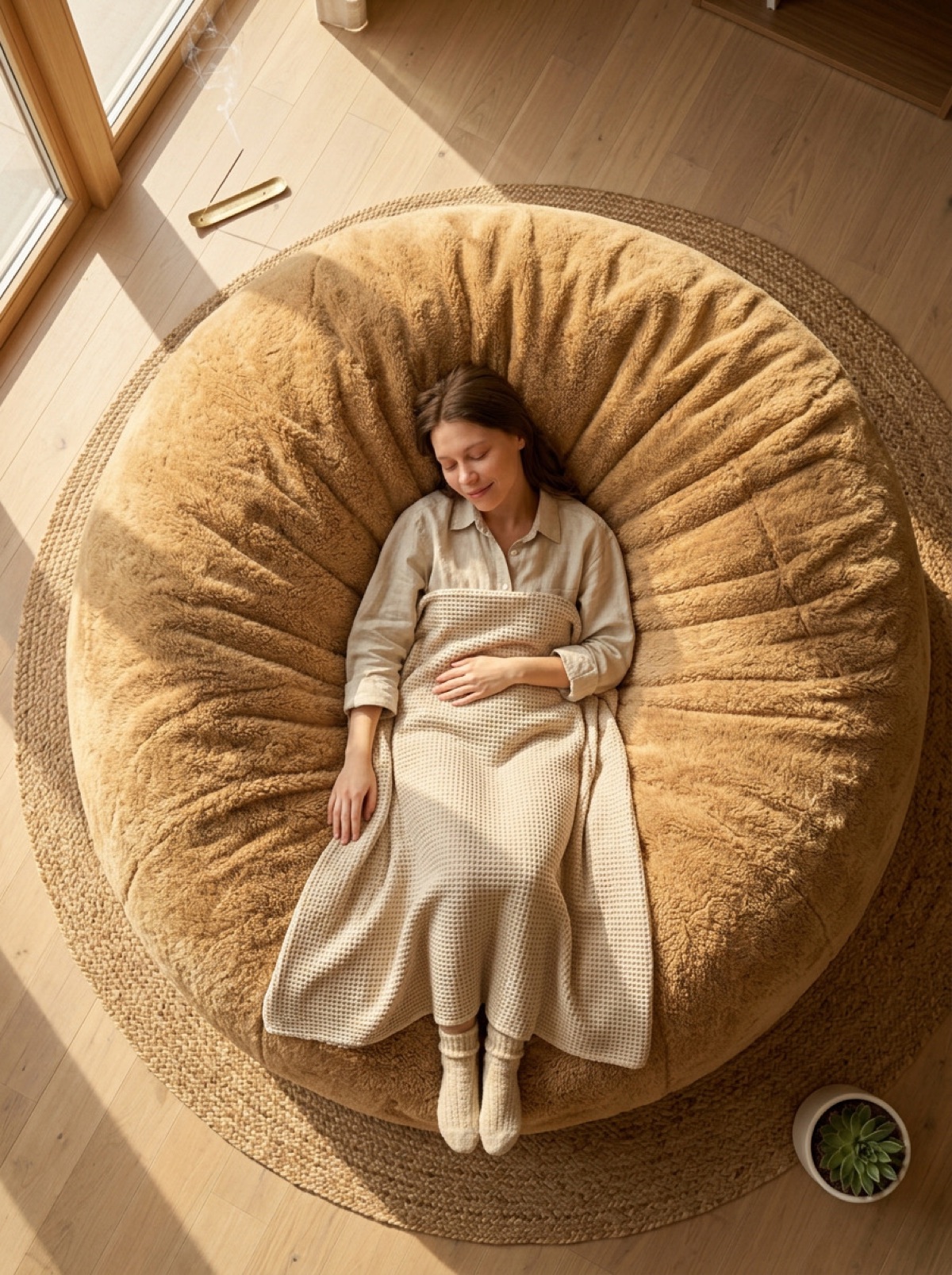
The Cosac is covered in premium sherpa or microsuede. The colors (charcoal, camel, ash, sky blue) are chosen for modern interiors. It sits on the floor with a grounded, organic look that adds warmth to a room. Think Scandinavian hygge, not fraternity basement.
Put one next to your existing sofa. It complements. And within a week, you'll notice guests sit on the beanbag first and the couch second. Every time.
Cleaning
Sofa maintenance is one of those things you're supposed to do and never actually do. Vacuum the cushions monthly, rotate them quarterly, spot-clean with fabric-specific solutions. If your sofa has non-removable cushion covers (and most do), a serious spill means calling a professional or living with the stain.
The Cosac cover unzips and goes in the washing machine. Pet hair, coffee, kid-related incidents: wash, zip, done.
The sherpa fabric releases pet fur more easily than most sofa upholstery, too. Microfiber couches grab hair and hold it hostage. Sherpa lets it go. (A lint roller between washes takes 30 seconds.)
The Sectional Question
Sectionals are the natural escalation when a regular sofa doesn't cut it. More surface area, an L-shape or U-shape, the promise of lounging without compromise.
They're also $2,000 to $5,000. They eat half the room. They require a dedicated wall configuration. And once they're in, they're bolted to that layout until you move out or call 3 friends with a truck.
The lounging part does improve. But the fundamental problem stays: you're still sitting on rigid foam that compresses after a few years. A $3,500 sectional with a saggy chaise by year 4 is a $3,500 sectional with a saggy chaise by year 4.
A Cosac 7ft ($399) gives you more lounging surface than most sectional chaises, in a package you can move with one hand. If the appeal of a sectional is "I want to lie down while I watch TV," the beanbag solves that at 10% of the cost.
Kids, Pets, and Real Life
Sofas and children have a complicated relationship. Kids jump on them. They spill things. They wedge Goldfish crackers into crevices you didn't know existed. Every sofa in a house with kids is slowly being destroyed. You just can't see it yet.
A beanbag handles all of this better. Kids can jump on it (that's actually the point). Spills hit a removable, washable cover. There are no crevices for snack debris because there's no frame, no cushion gaps, no armrest seams. It's one continuous surface.
Pets are the same story. Dogs sprawl across it. Cats knead the sherpa and fall asleep in the center. The cover goes in the wash when the fur builds up. A sofa with pet damage needs professional cleaning or reupholstery. A beanbag needs a spin cycle.
The 7ft Cosac is genuinely built for the whole pile: 2 adults, a kid or 2, and a dog draped across whatever's left. That's a normal Friday night in a house with kids. A sofa would need everyone to pick their own cushion and stay in their lane. A beanbag just absorbs the chaos.
Movie Nights, Naps, and the In-Between
Here's where lifestyle pulls ahead of specs. A sofa has one gear: sitting. You can lie on it, but you're working around armrests, cushion gaps, and a seat depth that wasn't designed for horizontal use.
A beanbag has every gear. Movie night: sink in low with the bowl of popcorn wedged between you. Sunday afternoon nap: it cradles you like a hammock without the sway. Working from home on a call that doesn't need your desk: lean back and let the foam do the work.
The number of things you'll use a beanbag for in a given week is probably 3x what you'd use a sofa for. That's the real value calculation. Price per use, not price per piece of furniture.
When a Sofa Wins
Sofas have real strengths. Formal entertaining, for one. A sofa says "adult dinner party" in a way a beanbag honestly doesn't.
If you have mobility issues and need a higher seat that's easier to stand up from, a sofa's raised height helps. If your living room is narrow and a couch against the wall is the only layout that works, the flat back uses that wall space efficiently.
But be honest about how often those scenarios describe your actual Tuesday night. If you're watching TV, reading, napping, scrolling, or hanging out with your family, those are all beanbag activities.
The 5-Year Test
Imagine you buy a $1,500 mid-range sofa today. In 5 years, the cushions have compressed into sad rectangles. The fabric has that specific shade of "we tried" after 2 professional cleanings. One armrest is slightly wobbly. You've been meaning to fix it for 8 months.
Now imagine you buy a Cosac 6ft ($299) today. In 5 years, you've topped off the foam twice ($60 total), washed the cover maybe 20 times, and it still feels like it did in month 1. Total investment: $359. Total hassle: almost none.
The sofa cost 4x more, required more maintenance, and declined every year. The beanbag cost less than a nice dinner for 2 (twice) and stayed the same. That math is hard to argue with.
The Best Setup
You don't have to choose. The best living rooms have both.
Keep the sofa for structure. It anchors the room, gives you a traditional option, and works for the moments when you actually want to sit upright. Then add a beanbag for everything else.
A 5ft Cosac ($249) fits next to most sofas without crowding the room. It becomes the preferred seat for movies, reading, gaming, and general lounging. The seating hierarchy flips within a week.
If you're furnishing a new space on a tight budget, one beanbag covers more use cases than one sofa at a fraction of the cost. You can always add a couch later. Start with the piece you'll actually use.
The Cosac ships free with a 60-day money-back guarantee. 332 reviews at a 4.7 average suggest you probably won't send it back.
See all 3 sizes and find yours →
See all 3 sizes and find yours →