You have a living room. You probably spent real money on it. A couch, maybe a loveseat, a coffee table you found on some design blog.
And you never sit in there.
Not really. Not the way you sit in your bedroom with your laptop propped on a pillow. Not the way you curl up on that one weird corner of the kitchen bench. You pass through the living room. You glance at it. You might sit on the couch for 20 minutes before migrating somewhere else.
The room looks great. It photographs well. But something about it doesn't pull you in.
The Showroom Problem
Most living rooms are designed backwards. You pick furniture that looks right for the space, then try to be comfortable in it. The couch fits the wall. The chairs match the rug. Everything is proportional and tasteful and arranged exactly the way a catalog would suggest.
Then you sit down and realize the cushions are too firm. Or the seat depth is wrong. Or the armrest hits your elbow at a weird angle. Small things. Nothing you'd return furniture over. But enough to make you unconsciously avoid the room.
This happens more than people admit. Most homeowners have at least one room they rarely use as intended. The living room tops the list.
62%. That's a lot of expensive square footage going to waste.
Comfort Is a Physics Problem
Here's what's actually happening. Traditional seating is rigid geometry. A couch is a flat surface with a back and arms. Your body is not flat. It's curved, asymmetric, and changes position every few minutes.
Rigid furniture forces you into a posture. You can slouch against it or sit up straight on it, but either way, you're conforming to the furniture's shape. After 30 minutes, something starts to ache. Your lower back. Your neck. That spot between your shoulder blades that never quite relaxes.
You don't consciously think "this couch is uncomfortable." You just get up and go somewhere else.
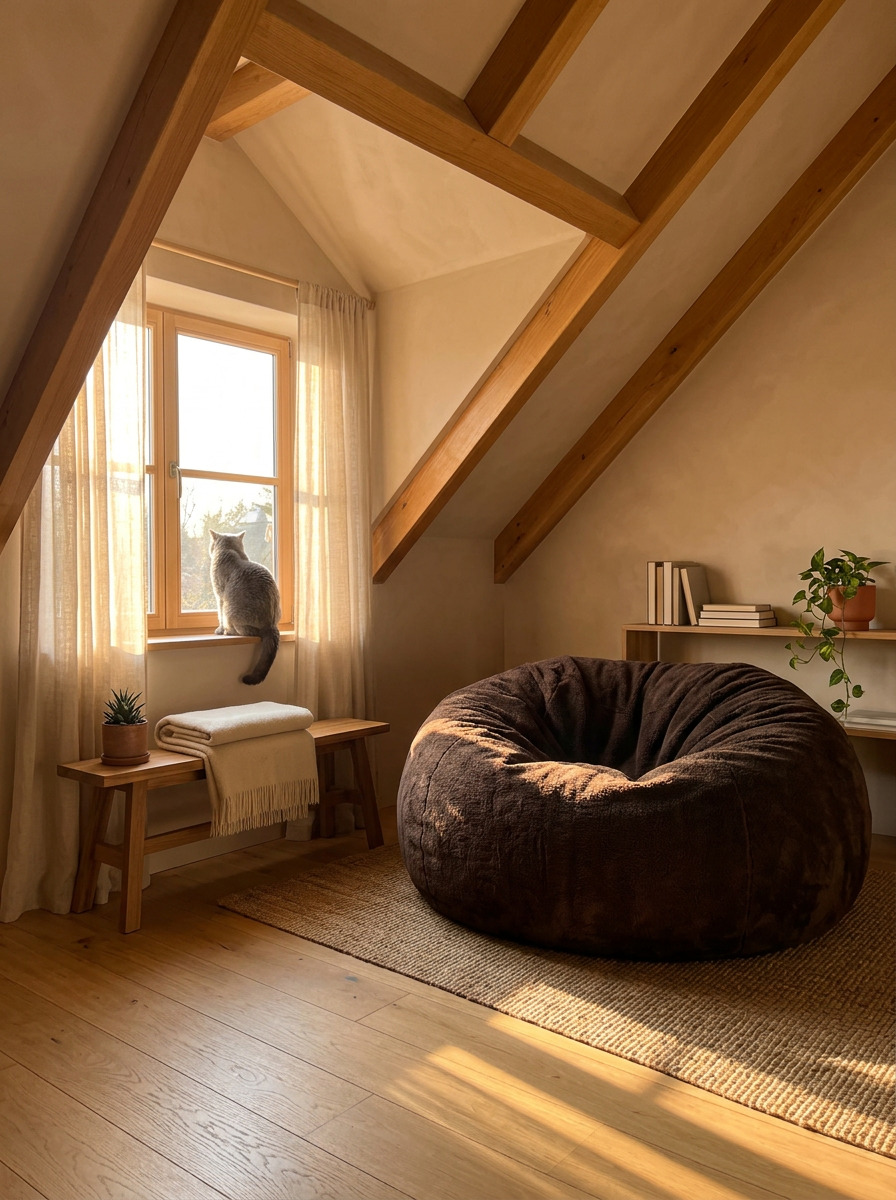
Furniture that conforms to your body instead of the other way around solves this at the physics level. A beanbag redistributes your weight across a much larger surface area. It supports the actual curves of your spine, not the theoretical ones a furniture designer imagined. And it does this automatically, every time you shift position.
That's why people sink into a beanbag and stay there for 3 hours without noticing. The micro-adjustments happen continuously. There's no accumulation of pressure points. No slow build of discomfort pushing you out of the room.
The Gravity Effect
Something interesting happens when you put genuinely comfortable seating in a room. People start using that room.
It sounds obvious, but watch it play out. The living room that used to be a pass-through becomes the place where everyone ends up on a Friday night. The kids do homework there. Someone falls asleep watching a documentary at 11 PM. The dog claims a permanent spot.
The room didn't change. The layout didn't change. The lighting is the same. But you swapped one piece of furniture, and suddenly the room has gravity.
Interior designers call this an "anchor piece." It's the thing that gives a room its purpose. For decades, that anchor was the couch. But couches are a compromise between seating capacity, aesthetics, and comfort. And comfort usually loses.
A Cosac beanbag doesn't compromise. A 6-foot beanbag seats 2 people comfortably (3 if you're friendly about it). It looks good in basically any room because its shape is organic and neutral. And it's more comfortable than anything else you'll put in that space.
"But Will It Look Weird?"
This is the question everyone asks and nobody needs to worry about. The mental image of a beanbag is stuck somewhere in 2004: a floppy nylon sack in a college dorm, leaking styrofoam beads onto a carpet that hasn't been vacuumed since orientation.
That's not what we're talking about.
A Cosac beanbag is covered in premium sherpa or microsuede fabric. The colors (charcoal, camel, sky blue) are specifically chosen to work with modern interiors. It sits on the floor with a deliberate, grounded look that actually adds warmth to a room. Think Scandinavian hygge, not fraternity basement.
Put one next to your existing couch. It doesn't clash. It complements. And within a week, you'll notice that everyone sits on the beanbag first and the couch second.
What Actually Changes
People who add a beanbag to their living room report the same pattern:
Week 1: Curiosity. Everyone tries it. There's a novelty factor.
Week 2: Habits start shifting. Movie nights migrate to the beanbag. Someone starts reading there instead of in bed.
Week 3: The beanbag has a permanent dent. (It springs back, but you know what I mean.) The living room is now the most used room in the house.
Month 2: Someone suggests getting a second one.
This pattern repeats because it's driven by something simple: people gravitate toward comfort. When the most comfortable spot in your house is in the living room, you'll spend more time in the living room. No redesign needed. No renovation. Just one piece of furniture that actually does what furniture is supposed to do.
The Math
A decent living room couch runs $800 to $2,000. It lasts maybe 7 years before the cushions flatten and the fabric pills.
A Cosac beanbag starts at a fraction of that. The cover is removable and machine-washable. The fill holds its shape for years, and you can top it off if it ever settles.
Cost per hour of actual use? The beanbag wins by a mile. Because you'll actually sit in it.
See the beanbag that's replacing couches
See the beanbag that's replacing couchesTry the Room Again
If you've got a living room that feels more like a hallway with furniture, the problem probably isn't the room. It's the seating.
One swap. That's all it takes to turn a showroom into a room you actually live in.