There's a book on your side table that you've been meaning to finish since February. You're three chapters in. You restart it every time you pick it up because you've forgotten what was happening. After 4 pages your phone vibrates and you put it down for the rest of the night.
The standard answer for why you don't read anymore is the phone. The phone is a factor (a big one). It is also downstream. The reason you reach for the phone instead of the book is that your couch is more comfortable to scroll on than it is to read on.
How Bad The Reading Decline Actually Got
Pew Research puts the share of US adults who read any book for pleasure in a given year at around 46%, a 30-year low. Gallup data shows the average American finishes about 12 books a year, down from 18 in the 90s, with a median of 5. A third of US adults read zero books last year.
The drop is steeper for younger readers. NAEP data shows the share of 13-year-olds who read for fun outside of school fell from 35% in 1984 to 14% in the most recent survey. The reading habit got pulled up by the roots in a single generation.
The narrative on this is uniform: phones killed reading. Algorithms shrank attention spans. Streaming replaced the bedside book. All true. All partial.
The piece that gets less air time is the physical environment. Reading is a posture activity. So is scrolling. Most homes built in the last 50 years furnished the second posture and not the first.
What Reading Actually Requires Of Your Body
A book weighs between 200 grams and 800 grams, held at chest level, often for an hour or more. Your eyes track downward at roughly 30 to 45 degrees from horizontal. Your hands need to be free of armrests or laps that would block them. Your body needs to be reclined enough that your neck isn't holding your skull up against gravity for 90 minutes.
That last one is the part most people get wrong. Long-form reading needs a head position where the skull is supported, not balanced. If your head is unsupported, your trapezius muscles fire to hold it up, and after 20 minutes you start feeling tension that you'll blame on the book.
Sustained reading also requires immobility. You can't fidget. You can't shift weight every 5 minutes. The body has to settle into the chair before the brain settles into the page.
Why Your Couch Is The Wrong Tool
A couch supports you in three places: back, butt, arms. Your head is unsupported unless you slump sideways onto an armrest, at which point your reading angle is wrong. Your hands are free but your arms aren't, because the depth of a couch cushion forces your elbows out.
Couches are designed around a different default. Hands free, screen at eye level, body upright enough to interact with what's in front of you. That's the TV posture. It's also the phone posture, the laptop posture, the conversation posture. It is not the book posture.
If you've ever tried to read a thick novel on a couch and given up after 15 minutes, this is why. The furniture is fighting the activity. You'd have to actively brace your body in an unnatural position to keep going, and you'd be doing it the whole time. (See also: nobody sits on their couch the way it's designed.)
And Bed Isn't The Answer Either
Bed solves the reclined posture problem. It also creates two new ones.
Sleep hygiene research is clear that mixing waking activities with the bed weakens the sleep cue. If you read in bed, watch TV in bed, eat in bed, and answer emails in bed, your brain stops associating the bed with sleep. Insomnia clinicians spend a lot of time telling adults to read somewhere else for this reason.
The other issue is propping. Holding a book up while lying flat means propping your head on a pillow stack that strains the neck, or holding the book overhead, which gets tiring fast. Most people who try it fall asleep at the bookmark and call it "I can only read at night."
The Shape That Actually Works
A reading posture wants four things at once: reclined torso (not flat, not upright), supported head, free hands, body still.
A few pieces of furniture hit all four. A high-backed reading chair. A recliner with a footrest. A floor cushion against a wall with knees up. A beanbag.
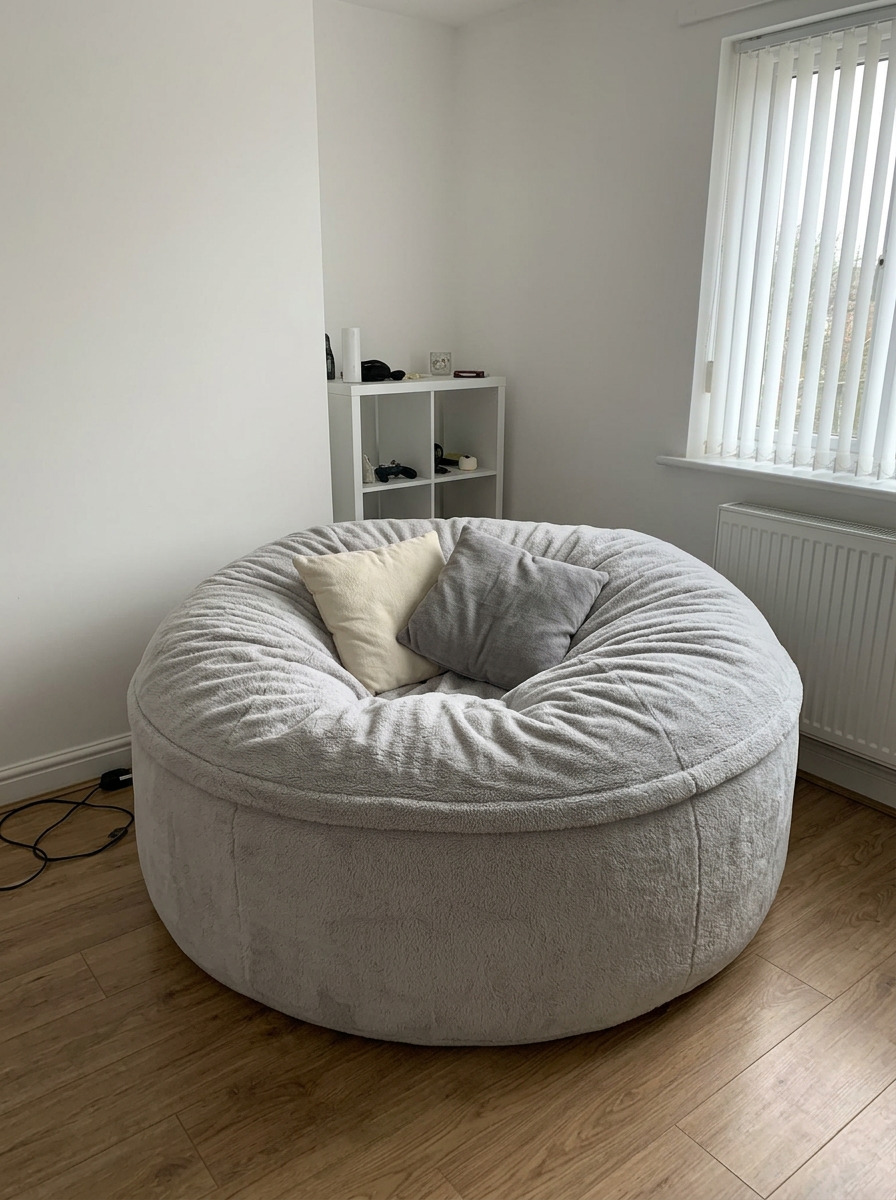
The beanbag version is the one that surprises people. A shredded memory foam beanbag wraps the back of your head, supports the small of your back, cradles your hips, and holds your knees just bent enough to relax. Your arms come naturally to chest level, where a book sits. You don't have to think about it.
The bonus is what the shape does to your physiology. The same wrap-around pressure drops your nervous system into rest-and-digest, which is the state where attention actually consolidates. Reading goes deeper when your body is calm, not just when your willpower is high.
Japan Has Been Quietly Solving This For A Thousand Years
A traditional Japanese reading space is low. Zabuton cushion on the floor, a wall or shoji screen at the back, a low table at the side. The body is reclined into the floor, the head is supported by the wall, the hands are free, the eyes drop naturally to the page.
The Western adoption of this idea is called a "reading nook," which is the design-magazine name for the same setup. A corner. A soft low seat. A throw blanket. Often a window. The aesthetic is Pinterest. The ergonomics are 12th-century Kyoto.
The 2026 design press has been calling this a Japandi revival. Floor seating, low furniture, "cocoon corners." The pieces look like decor, but they're doing the work of solving an attention-and-posture problem that modern Western furniture stopped solving sometime in the 1950s.
The 90-Minute Test
If you want to know whether a piece of furniture supports reading, do the 90-minute test. Sit in it with a book. Don't try to read longer than you naturally would. See when your body taps out.
A couch will dump you out at 18 to 25 minutes (neck strain). A bed will end at 35 to 50 minutes (sleep). A dining chair won't get past 8. A recliner with a footrest can hold 60 to 90. A beanbag, if it's the right kind, holds 90 to 180. Owners describe the same pattern across hundreds of reviews:
"reading in the cosac is my new favorite thign" (Emma R., 5ft Charcoal)
"my reading corner is complete" (Grace M., 6ft Ash)
"got the 3ft for my reading nook and it fits perfectly. so cozy" (Hana L., 3ft Camel)
"I work from home and this has been a game changer for my reading nook" (Olivia S., 5ft, Australia)
Read that as data, not as marketing. The pattern across reviews isn't about the chair. It's about the activity returning. Reading came back.
What To Actually Do This Week
If you want to read more, the productivity-blog advice (book club, app, reading streak) treats the symptom. The intervention that works is changing the environment around the book.
Three moves, in order of impact.
One: pick a single piece of furniture that is for reading and is not for screens. A reading chair, a beanbag, a floor cushion with wall support. The single-purpose-furniture rule is what makes the cue stick. Your brain learns: I sit here, I read.
Two: put the phone in a different room when you sit down. The Marie Kondo move, not the Pomodoro move. Distance beats willpower across every behavior-change study that's ever been run.
Three: have a book on the seat already. Not on the shelf. On the seat. The friction of going to get a book is the friction that loses to the phone every time.
A Short Note On Cosac
The 5ft, 6ft, and 7ft versions all work for reading. The 5ft is the dedicated single-reader option, the size people put in a corner with a lamp. The 6ft is the one most people land on (room to fold a leg up, room for a cat to join, still fits a normal apartment). The 7ft is for households where the reading chair becomes a fight.
Sherpa fleece cover for cold-weather reading. Charcoal or Ash for the dark-academia aesthetic. Camel for the warm-light reading-nook look. Sizing guide is here if you're not sure which footprint fits your space.
5ft is $249. 6ft is $299. 7ft is $399. Free shipping in the US, Canada, and Australia. 60-day money-back guarantee, so the chair earns the reading-revival outcome before you commit.
Sources & Further Reading
• Pew Research: Americans And Reading
• Gallup: Americans Reading Fewer Books Than In Past
• NAEP: The Nation's Report Card On Reading
• Sleep Foundation: Bedroom Environment And Sleep Cues
• Cosac: Why Sinking Into A Beanbag Calms Your Nervous System